What a part number actually tells you
A part number (also called an MPN, manufacturer part number, or OEM part number) is the single most reliable key to the spare part you need. When you enter one correctly, you are not guessing at a component — you are matching against a manufacturer's own catalog identity. That is why every sourcing and cross-referencing workflow in industrial procurement starts here.
The right part number answers three questions at once:
- What is it? The model or component the number identifies.
- Which variant? The exact configuration, revision, or option coded into the number.
- Who makes it? The OEM and its authorized supply channel.
Read the number carefully, because the difference between a working part and a costly wrong order is often a single digit, letter, or suffix.
Start with the physical part, not the screen
Before you type anything into a search box, gather what is actually on the machine. A part number that lives on a nameplate, a label, or a box is far more reliable than one remembered or typed from a worn tag.
- Photograph the nameplate. A clear photo of the rating plate preserves the exact spacing, hyphens, and case that a search depends on.
- Capture the full string. Do not stop at the part that looks like "the code." Many components carry both a product code and a serial number; only one of them is the part number.
- Record the surrounding details. For motors and drives, also note the voltage, current, power rating, speed, and frame size. These support the part number and help confirm a match when numbers overlap across variants.
What to write down
Have this list ready before you search or send a request:
| Field |
Example |
Why it matters |
| Manufacturer (OEM) |
ABB |
Filters results to the correct brand family |
| Part number (MPN) |
3GGL132213 |
The primary search key |
| Serial number |
— |
Traces the exact unit, not the part family |
| Rated power / voltage |
30 kW, 400 V |
Confirms the electrical variant |
| Application |
Cooling tower, pump |
Catches a part ordered from the wrong context |
A common mistake is treating the serial number as the part number. Serial numbers identify an individual unit; part numbers identify a specifiable product. Mixing them up is one of the most frequent reasons a "correct" search returns nothing.
How to search for the part number correctly
When you have a clean part number, search it in the most structured way possible:
- Copy, do not retype. Typing long alphanumeric strings invites character errors — a "0" becoming an "O," a "1" becoming an "l."
- Search the exact string first. Start with the unmodified part number. If you find nothing, only then try partial matches.
- Remove brand confusion. If your search engine indexes many brands, add the manufacturer name to narrow the results.
- Use the manufacturer's own catalog when possible. The OEM's catalog or configurator is the ground truth for how a number maps to a specification.
- Beware of whitespace and punctuation. Trailing spaces, and misplaced hyphens or dashes, are enough to make a valid number unrecognizable.
If you do not have the part number at all, work backward from the assembly: identify the machine and the subsystem (motor, drive, valve, filter), then look up the subsystem's parts list or spare-parts manual. A spare-parts manual from the OEM is usually the fastest way to find the correct number for the item that failed.
When the part number does not exist, use cross-referencing
Not every situation gives you a clean OEM number. The equipment may be obsolete, the label may be worn, or the manufacturer may be out of the supply chain. In these cases, a cross-reference (a compatible or equivalent part number from a different brand) is the fallback.
Cross-referencing works by matching the physical and functional characteristics of a part to a known equivalent. It is never a blind brand substitution. A responsible cross-reference confirms:
- Critical dimensions (mounting, shaft, bore, connection size).
- Electrical and performance ratings (voltage, current, power, speed, torque).
- Material and sealing requirements for the application environment.
- Regulatory or hazardous-area compliance where applicable.
An interchange must be verified before it is trusted. If you have doubts, provide the OEM number to a sourcing partner that can cross-reference it against verified supply rather than accepting an unverified match.
Verify authenticity before you install
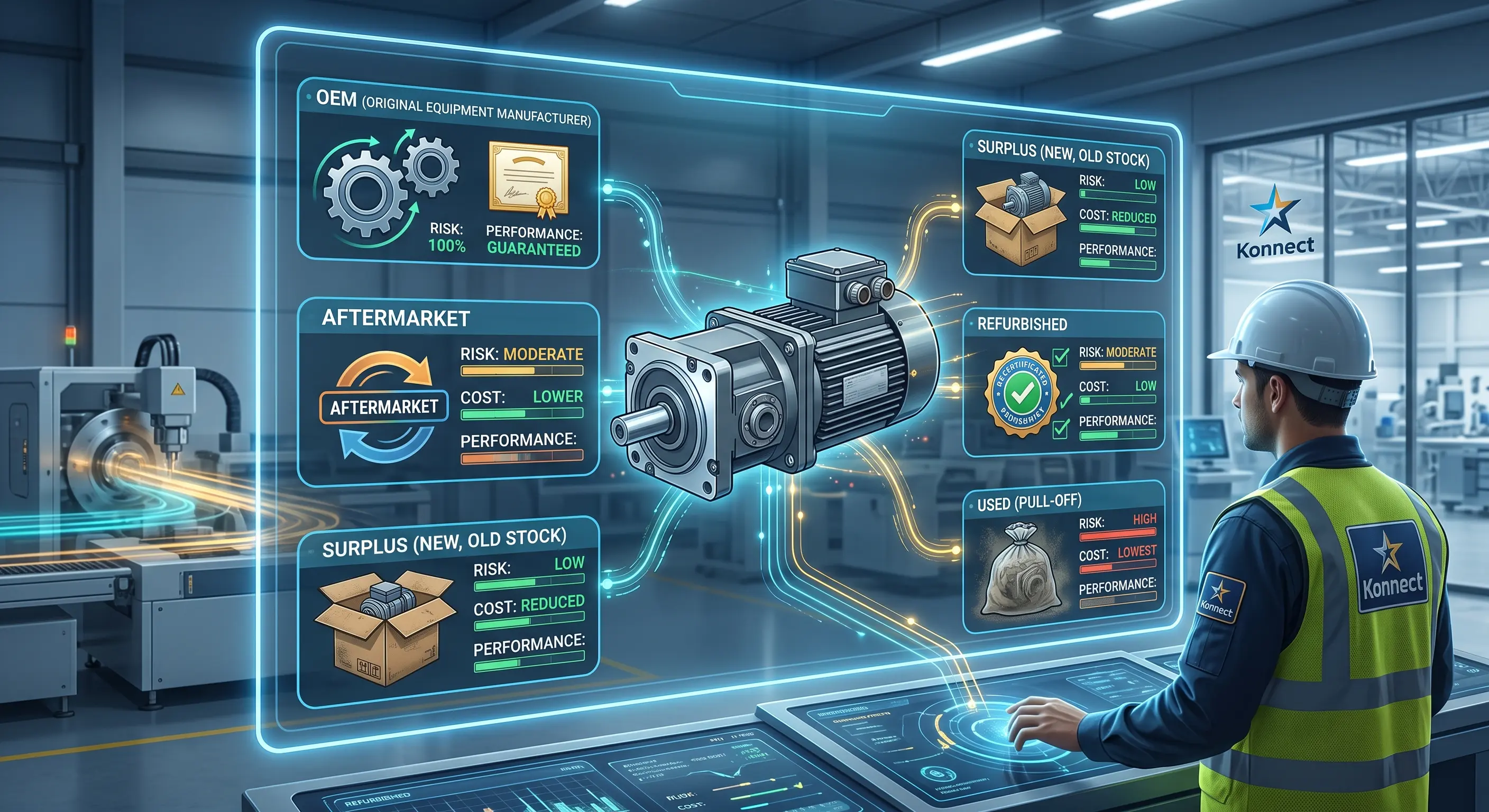
A correct part number alone is not enough. The number identifies what you want; the supply channel determines whether what arrives is genuine. Counterfeit, relabeled, or refurbished components remain a real risk in the spare-parts trade, and a wrong part can fail immediately or fail your plant downstream.
Practical checks at receiving:
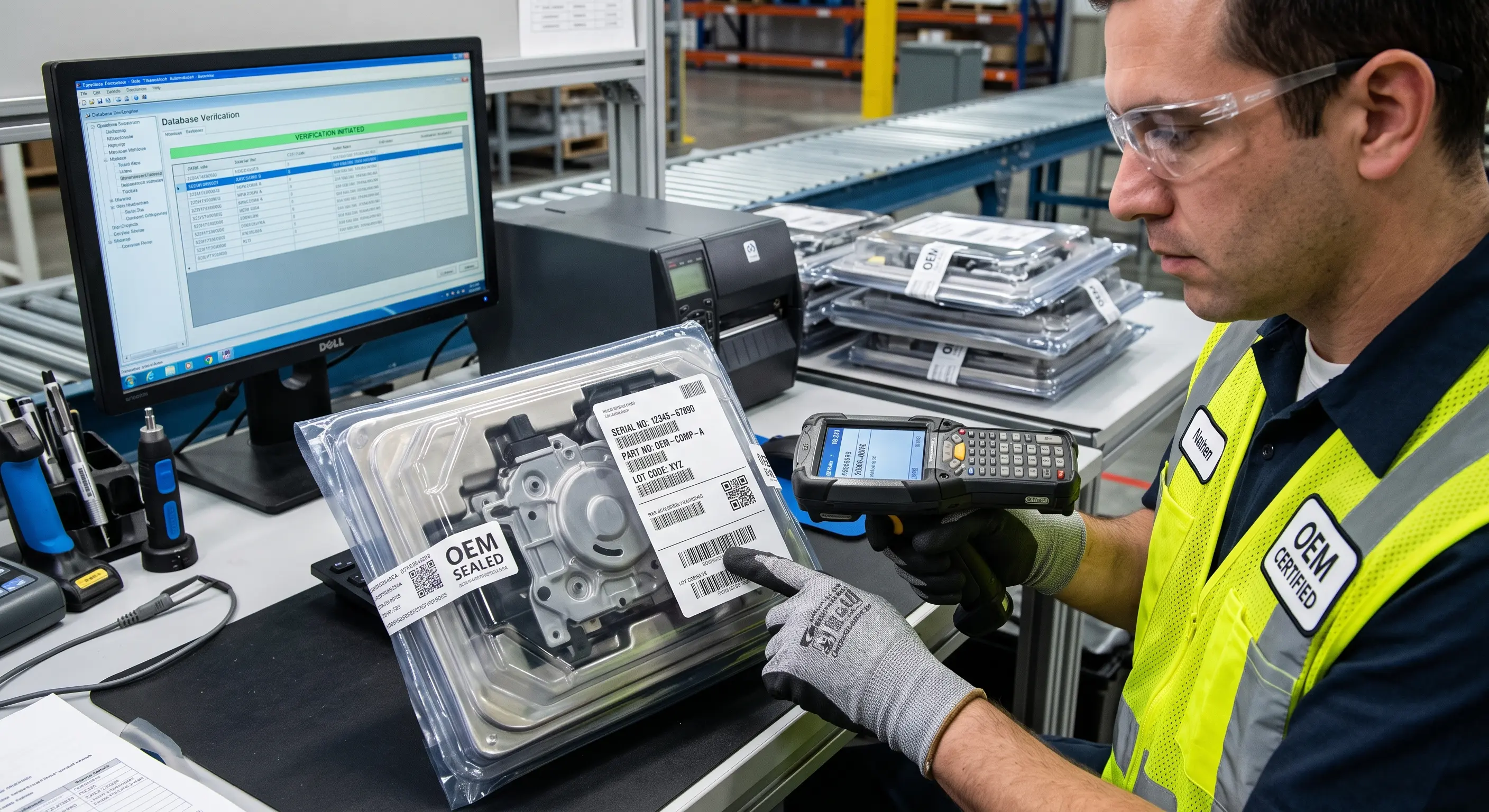
- Original packaging and seals intact, with correct labels.
- Serial and batch traceability that matches the order and the OEM.
- Nameplate details that line up with the specified part number.
- Documentation — Certificate of Origin, COO, or manufacturer verification where your QC requires it.
In the industrial spare parts trade, quality is a process, not a promise. The most reliable sourcing route is a supplier that can document the verification of each stage: supplier acceptance, label and serial verification, condition classification, pre-shipment inspection, and a formal discrepancy procedure.
Common pitfalls and how to avoid them
Even with a correct part number, orders go wrong. Watch for the repeated problems:
- Ignoring the revision or suffix. A suffix like "-R" or a revision letter changes the variant; ordering without it can return the wrong component.
- Substituting brand-new for used. If your order requires brand-new OEM stock, say so explicitly and verify the condition grade.
- Guessing a cross-reference. Only use verified equivalents, not an assumption that two brands "should" be interchangeable.
- Searching for the serial number. Use the part number, not the serial, as the search key.
- Tying a part to the wrong application. The same component can appear in several machines; confirm it against the unit you are repairing.
When in doubt, hand the part number to a sourcing specialist
When a part is critical, long-lead, or hard to identify, the fastest path to a correct part is often to give the part number to an experienced sourcing desk. A good request includes the part number, the manufacturer, a photo of the label, and the quantity required — plus any special conditions such as delivery deadline or documentation.
At SparePartsMap, we match part numbers against a verified sourcing network of 680+ manufacturers and more than 42,000 indexed components across 36 countries. Our team handles OEM specifications, part interchangeability, and technical cross-referencing, then responds with a clear quote, availability, and lead time within 24 hours — all backed by a documented five-stage quality process. Send us the part number, and we will map the supply.