Every maintenance manager eventually faces the same question when a machine goes down and the original part is either expensive, discontinued, or weeks away: can I use something cheaper than a brand-new original? The answer is rarely a clean yes or no — it depends on what you mean by "cheaper" and what the part does.
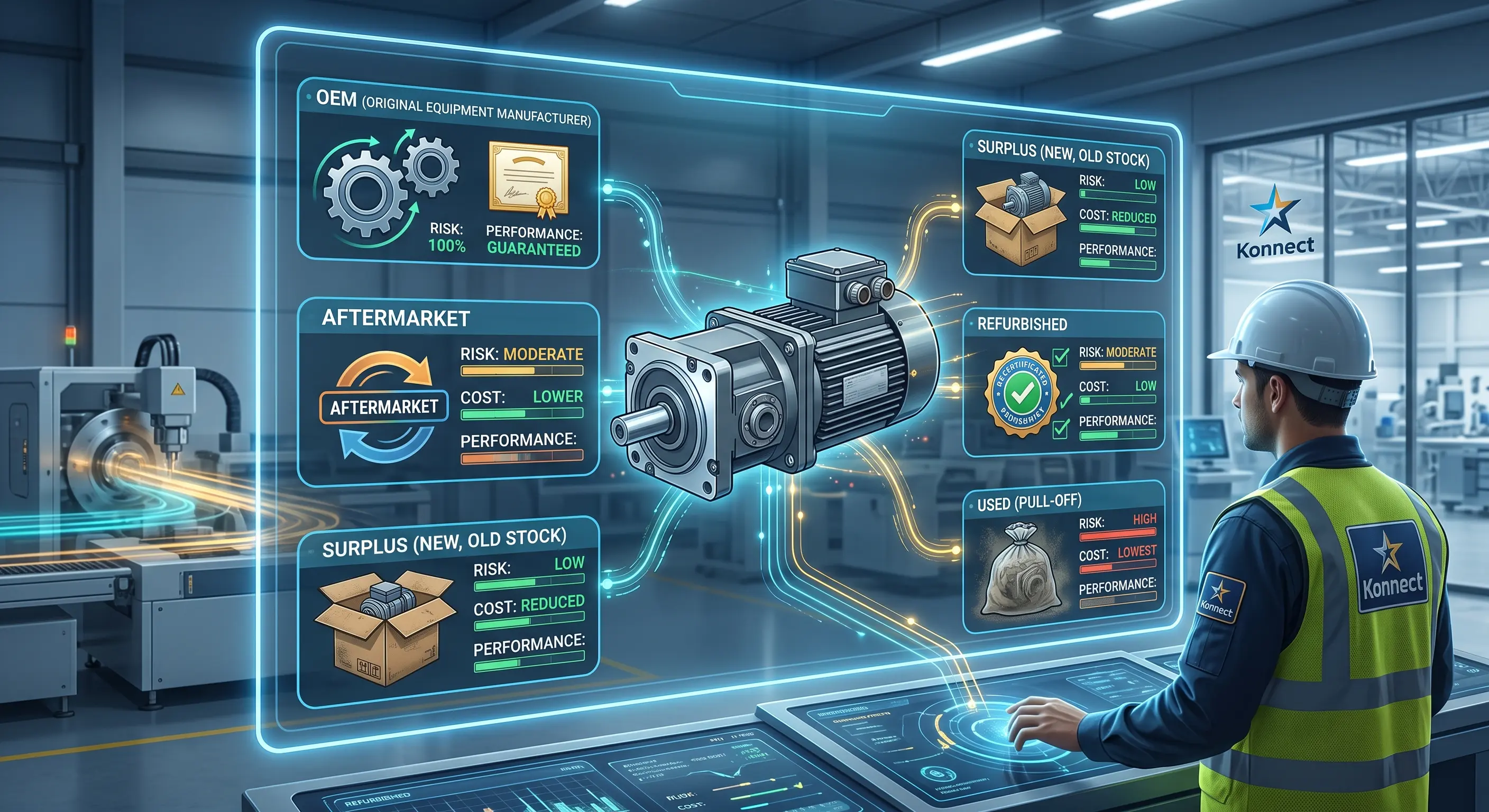
This guide explains the real differences between the five main sources of industrial spare parts — OEM, aftermarket, surplus, refurbished, and used — and gives you a decision framework so you can weigh cost against risk instead of guessing.
What the terms actually mean
A lot of the confusion comes from people using these words interchangeably. They are not the same.
| Part type |
Made by |
Condition |
Warranty |
Typical use case |
| OEM (Original Equipment Manufacturer) |
The part's original maker |
New |
Full |
Critical, safety-related, or warranty-covered equipment |
| Aftermarket |
A third party, not the OEM |
New |
Varies by maker |
Common parts where a spec match is easy to verify |
| Surplus / New Old Stock (NOS) |
The OEM |
New, but warehoused |
Limited or none |
Discontinued equipment still in service |
| Refurbished / Remanufactured |
OEM or a qualified shop |
Rebuilt to a spec |
Partial, shop-dependent |
Expensive, serviceable components |
| Used |
Any |
Removed from service |
None |
Low-risk, low-cost, or end-of-life fill-ins |
OEM parts: the quality benchmark
An OEM part is manufactured by the original equipment manufacturer and built to the exact specification of the component it replaces. When the manual for your ABB motor specifies an OEM replacement, the part matches the form, fit, and function of the original, and the manufacturer stands behind it.
Advantages
- Known quality and verified specifications
- Full manufacturer warranty and technical support
- Traceability and documented materials
- Safest option for safety-critical, certified, or under-warranty equipment
Disadvantages
- Highest price
- Longest lead times
- Not available for every legacy or discontinued product
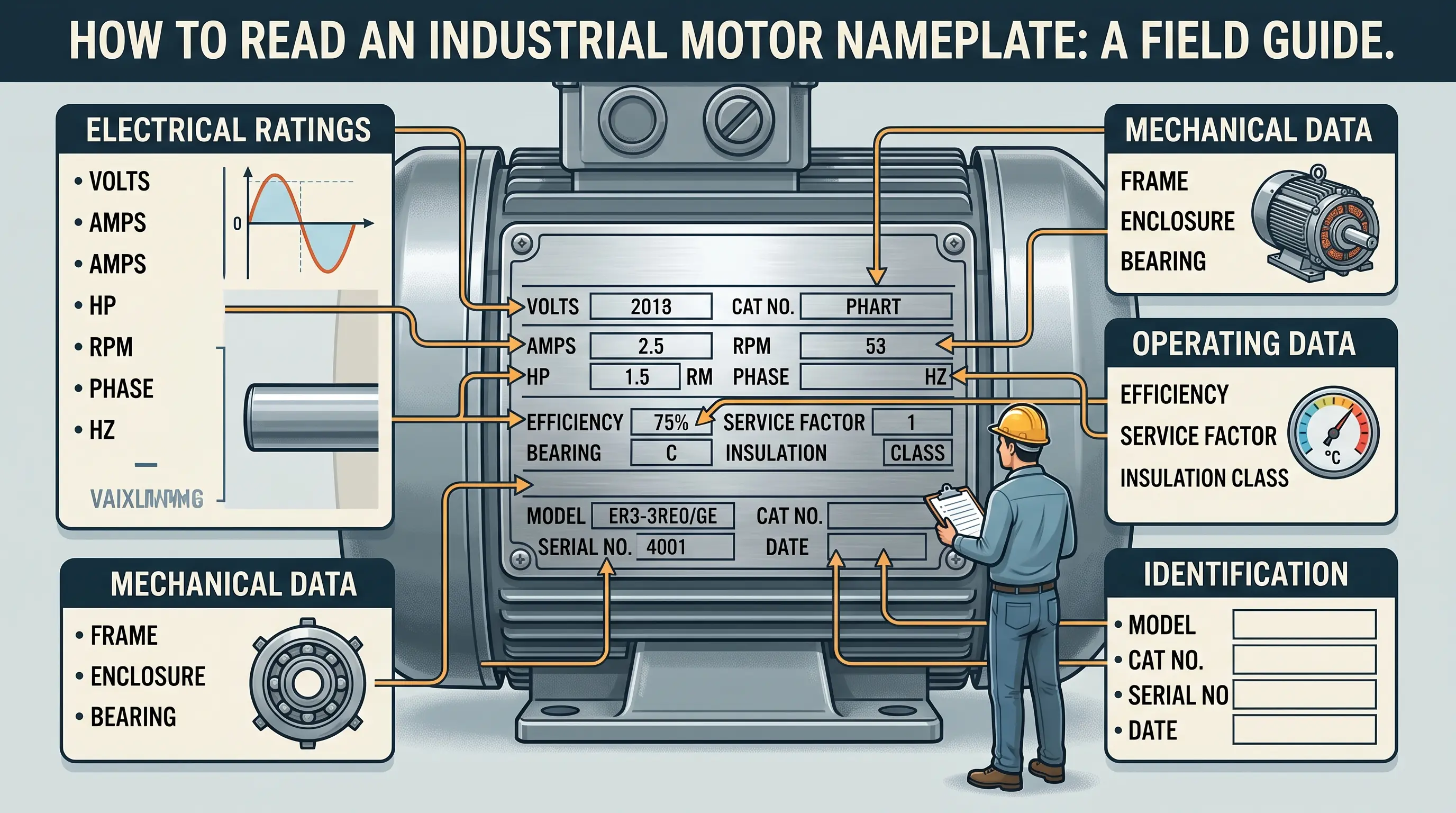
Choose OEM when the part is safety-critical, carries regulatory certification (ATEX, IECEx), or is covered by a warranty you don't want to void. For our guide on reading nameplates and matching certified motors, see how to read an industrial motor nameplate.
Aftermarket parts: a new build from a third party
An aftermarket part is manufactured new by a company other than the original maker. It is not used and not refurbished — it is brand new, but not from the OEM.
Advantages
- Often cheaper and faster than OEM
- Plenty of suppliers and price competition
- New condition with no wear
Disadvantages
- Quality varies dramatically by manufacturer
- May not carry the OEM's certification
- Warranty is only as good as the third-party supplier
Aftermarket works well for commodity parts (bearings, gaskets, common contactors, fuses) where the specification is standard and verifiable. It is riskier for precision, calibrated, or safety-certified components. Always confirm the third-party part meets the same specification and carries the same approvals as the OEM part it replaces.
Surplus and new old stock (NOS): new, but from another era
Surplus parts are new, unused original parts that were made but never sold. When a product line is discontinued, distributors often keep genuine stock — called new old stock (NOS) — for years.
Advantages
- Genuine OEM quality at a discount to current list price
- The only option for legacy and discontinued equipment
- Available fast for aging installed bases
Disadvantages
- Storage age means materials, seals, and gaskets may have degraded
- Warranty is usually limited or unavailable
- No way to return if the fit is slightly off
Surplus is often the best option for obsolete equipment still running on your site. Before ordering NOS, ask the seller about storage history and any warranty. For the full walkthrough, read our obsolete and discontinued industrial parts sourcing checklist.
Refurbished parts: repaired to a specification
A refurbished part is a used unit that has been disassembled, inspected, repaired, and tested to bring it back to a defined performance standard. "Remanufactured" is a stricter form of this, where the part is returned to like-new condition to the original spec.
Advantages
- Substantially cheaper than new
- Can be the only path for an expensive, custom, or discontinued component
- Testing records can be more detailed than a generic new part
Disadvantages
- Quality depends entirely on the rebuilder's standards
- Limited or shop-only warranty
- Not suitable for safety-critical or certified applications
Refurbished works well for high-value, serviceable components such as servo drives, circuit boards, gearboxes, and large relays — the kind of part where a full OEM replacement is disproportionately expensive. If the item is still under active OEM support, compare the cost of a repair program (OEM refurbishment) against a third-party refurb.
Used parts: the raw secondhand market
A used part is simply removed from service and sold as-is. It may have life left in it, or it may not. There is no inspection or repair standard and no warranty.
Advantages
- Lowest upfront cost
- Immediate availability for urgent breakdowns
- A good source of donor material or non-critical spares
Disadvantages
- Unknown remaining service life
- No warranty or traceability
- Hidden wear, damage, or contamination
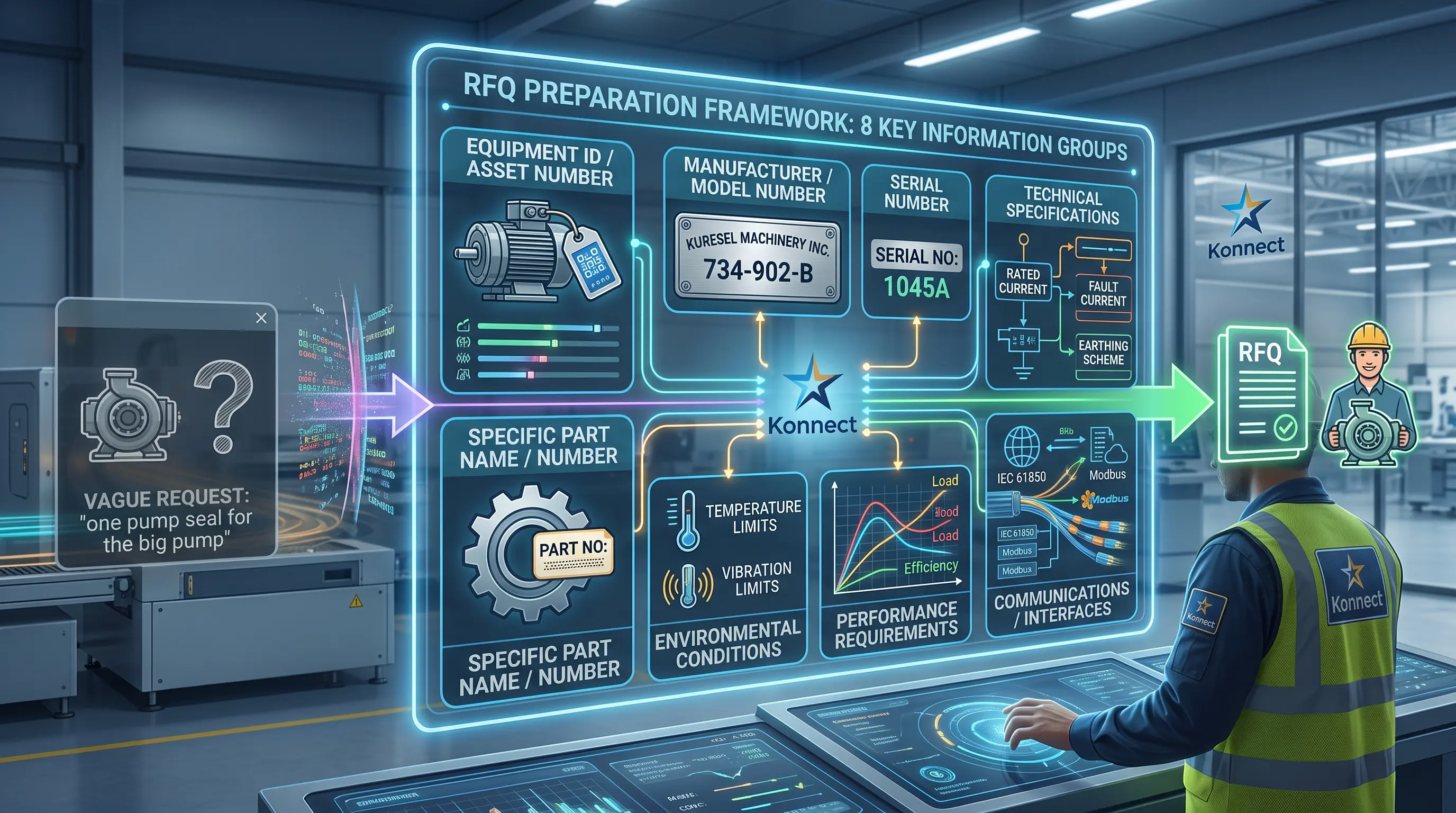
Use used parts sparingly — for non-critical, easy-to-replace components, or as interim spares while a proper replacement ships. Never use an untraceable used part in a safety-critical role. Whatever the category, confirm you are ordering the correct item by finding the right part from its part number.
How to choose: a decision framework
Ask these questions in order before you spend money:
- Is the application safety-critical or regulated? If yes, buy OEM (or an approved certified refurbishment from the OEM). Stop here.
- Is the equipment under an active warranty? If yes, use OEM to protect the warranty. Stop here.
- Is the product discontinued? If yes, surplus/NOS is your best option, and a certified refurbishment is second.
- Is the part high-value and serviceable? If yes, a reputable refurbishment is usually the strongest cost-quality balance.
- Is the part a standard commodity? If yes, an aftermarket or refurbished unit with a verifiable spec is reasonable.
- Is it a non-critical, non-permanent fill-in? Only then consider used.
The worst mistakes we see are the reverse: using a used or untraceable part where a safety decision is at stake, or paying OEM prices for a discontinued product that a surplus supplier can deliver at a fraction of the cost. Getting the category right for each asset — not applying one policy to everything — is the real skill.
Summary
- OEM = safest, most expensive, and best for safety-critical and in-warranty equipment.
- Aftermarket = new but third-party; fine for verifiable commodity parts.
- Surplus / NOS = genuine, unused, and often the only route for discontinued gear.
- Refurbished = used but rebuilt to a standard, ideal for high-value serviceable components.
- Used = cheapest and riskiest, for non-critical fills only.
Match the part category to the risk profile of the application, verify warranty and certification, and always confirm you are buying the correct item. That is how you keep machines running without overpaying or gambling on safety.
Need to source an exact OEM or certified replacement part? Search the catalog, or ask our sourcing team to cross-reference the manufacturer and part number you already have.