Don't let an obsolete part stop your plant
Almost every industrial facility has a part in storage that was discontinued years ago. Maybe it's a control card, an old drive, or a relay that no longer even appears in the catalog. Because production machinery runs for decades, it's nearly certain that one of these parts will be needed again someday. The problem is that when that day arrives, the part will likely be obsolete or discontinued.
This article provides a checklist to protect your operation when sourcing end-of-life or obsolete industrial parts. The goal is simple: get the right part, from the right source, within a reasonable timeframe, and without taking unnecessary risks.
Start by clarifying the terms
Before you begin sourcing, it's critical to name the situation correctly. "Obsolete" and "discontinued" are often used interchangeably, but they are not the same thing.
- Discontinued: The manufacturer no longer produces or actively sells the product, but support and spare-part availability may continue. This is the easiest scenario, because the part can still be accessed.
- Obsolete: The manufacturer has fully withdrawn support — production, service, and often original spare-part supply have ended. In this case the part can only be found through third parties, brokers, or used sources.
Distinguishing the two determines which sourcing strategy to follow. It also helps to know the common product life cycle stages used in industry: active production, end-of-life (EOL) announcement, end of service and support, and full removal. When manufacturers announce EOL in advance, you may still have a window to buy the part while it exists.
Pre-sourcing checklist
Finding an obsolete part requires more preparation than ordering a new one. Work through the following steps in order.
1. Identify the part precisely
Starting a search without knowing exactly what you're looking for can consume days. On old parts, labels may be worn, serial numbers faded, or replaced. So:
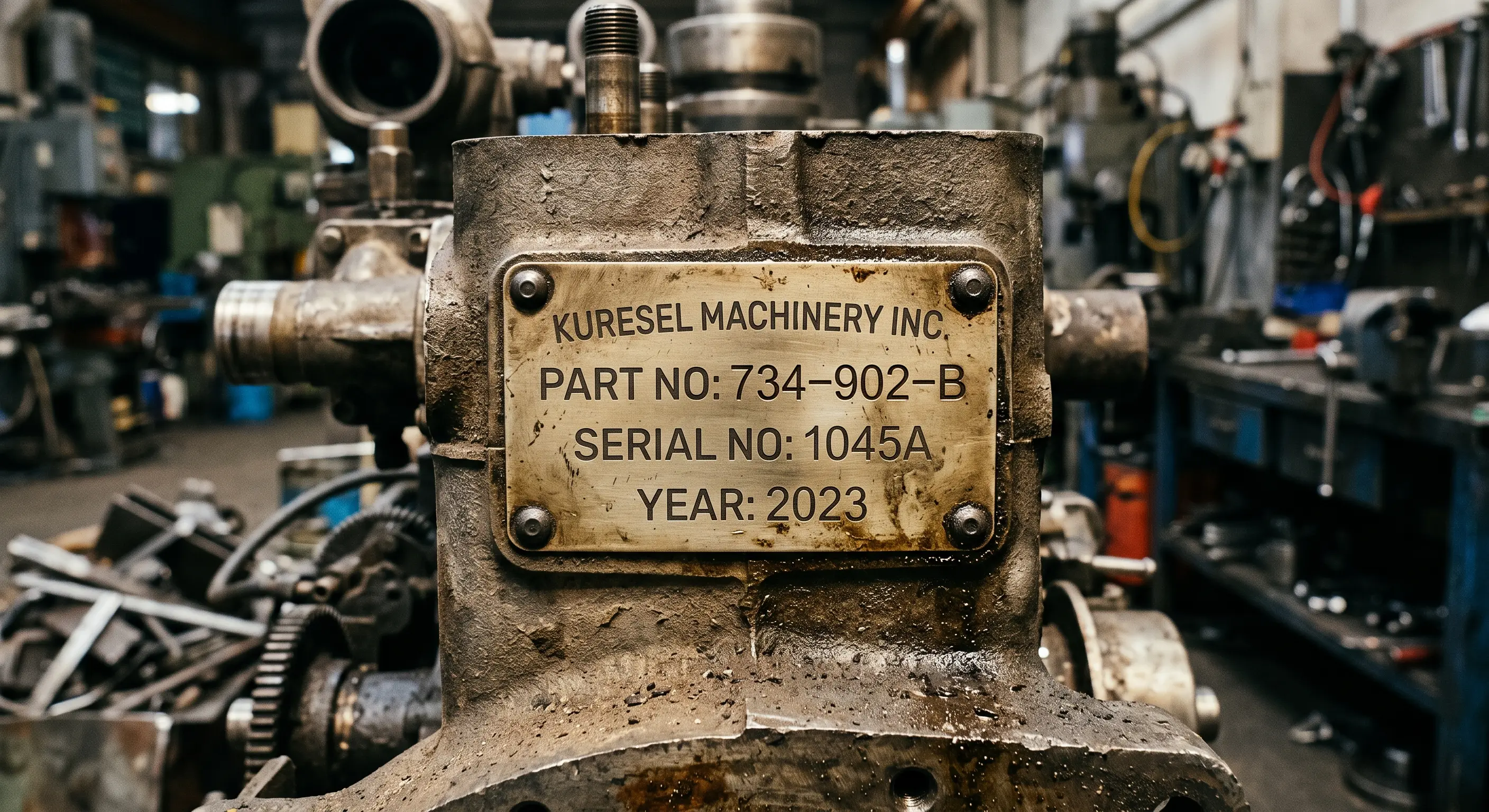
- Take a clear photo of the old part's label or nameplate. Many products carry both a product code and a serial number; the product code is the part number.
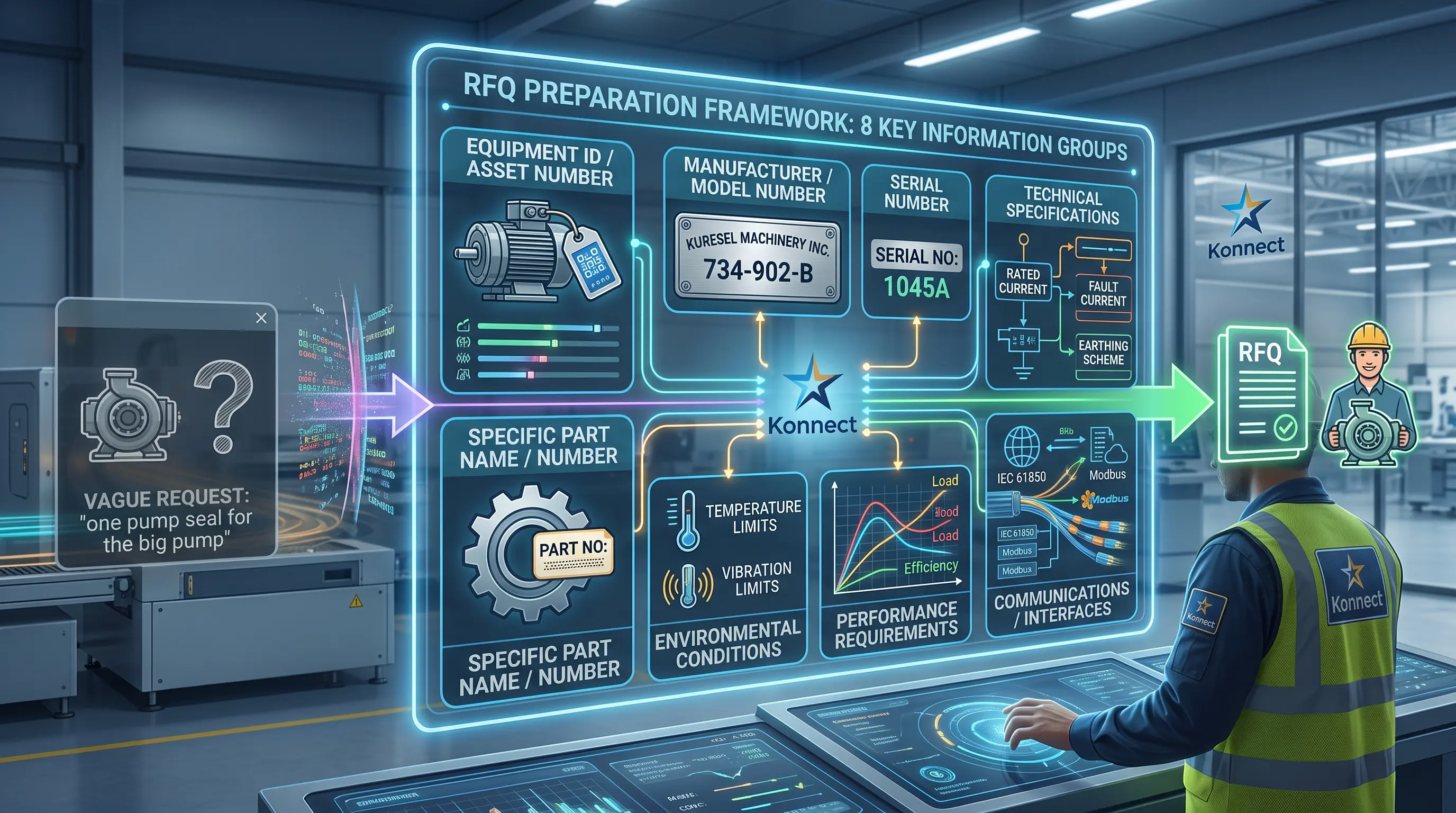
- Note the manufacturer (OEM), part number (MPN), serial number if available, and any revision or suffix separately.
- Record the machine, application, and operating conditions (voltage, current, power, temperature, protection class). The same part may be used in different machines, so application details help verify a candidate.
2. Check the replacement part
For most obsolete parts, the manufacturer has often produced a newer model that replaces it. This is the cheapest and most reliable route, because the manufacturer has formally verified compatibility.
- Look for "replacement," "successor," or "superseded by" information on the manufacturer's site.
- Always verify the electrical and mechanical compatibility of the replacement. Being from the "same family" does not mean it has the same connection diagram.
- Confirm the official approval from the manufacturer's selection or interchange table.
3. Try the manufacturer channel and distributors
Even an obsolete status can sometimes be covered by manufacturer stock for a few more years. Some manufacturers keep the part in stock for the support period.
- First request from the manufacturer's official dealers and authorized distributor network.
- Know the EOL date; if the "last buy" date has not passed, your window for bulk purchase may still be open.
- Even if production has truly stopped, check whether authorized channels offer stock or service.
4. Find an alternative by cross-referencing
For most obsolete parts, several manufacturers produce compatible units. Cross-referencing finds an equivalent part from a different manufacturer by matching physical and functional characteristics.
A proper cross-reference should verify:
- Critical dimensions (mounting, shaft, bore, connection sizes).
- Electrical and performance values (voltage, current, power, speed, torque).
- Material and sealing requirements.
- If required, regulatory compliance documents (ATEX, CE, hazardous area).
Cross-referencing is never a blind brand-swap. Never rely on the assumption that "two brands are already the same"; the comparison must be based on a technically verified equivalent. If you are unsure, send the part number to a supplier who can find a verified substitute for you.
5. Use third-party distributors and open sources
When the manufacturer and distributor paths close, independent and excess stock markets step in. These channels are the most common source of obsolete parts.
- When searching the industrial spare-parts market, add the manufacturer alongside the part number to narrow results.
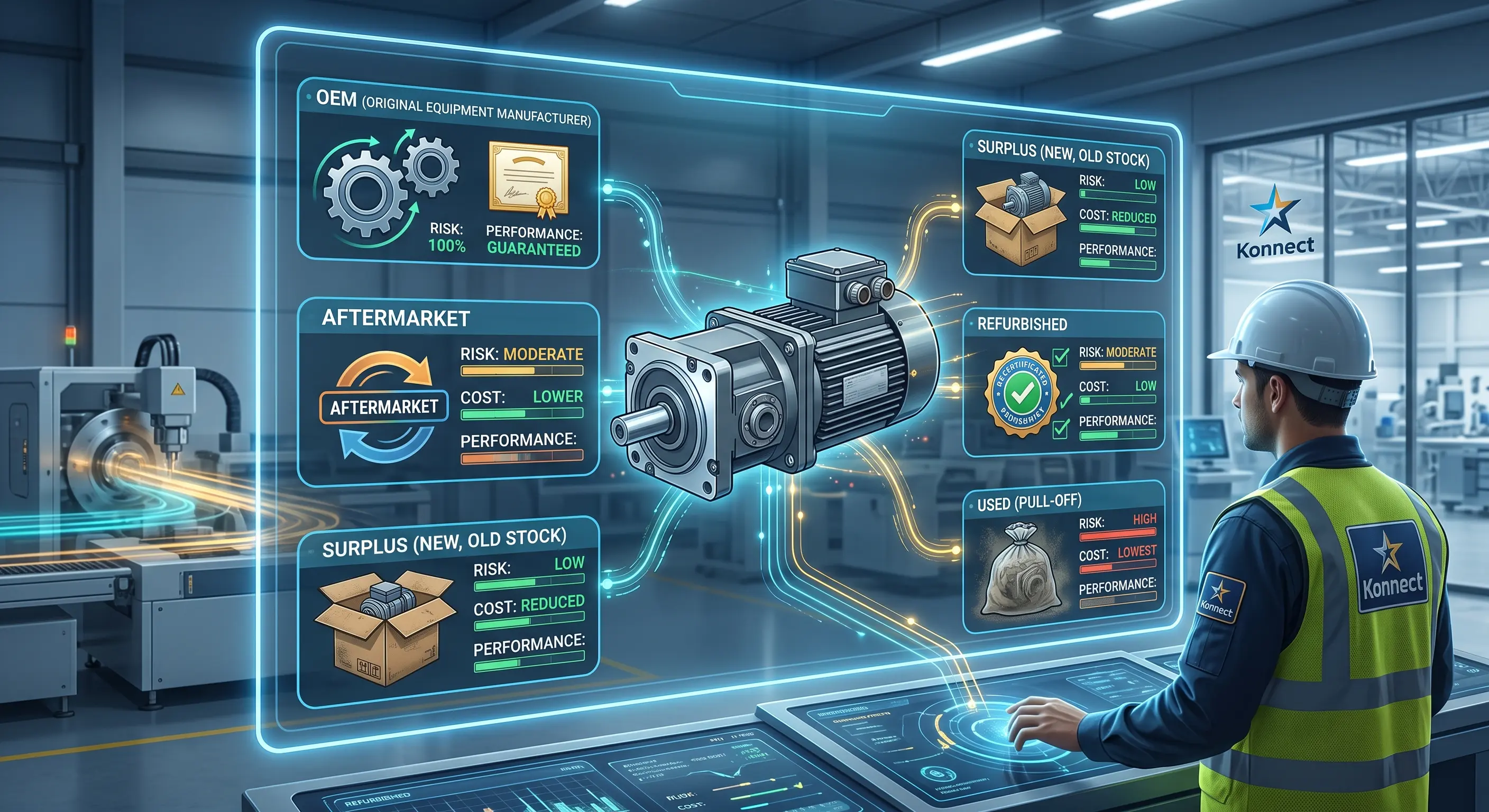
- Clearly confirm with distributors whether the product is really in stock and whether it is new / used / rebuilt.
- A low price and an instant "in stock" promise must always come with origin verification.
6. Consider alternatives: repair, rebuild, emulation
If the part cannot be sourced from anywhere, the path is to keep the operation running rather than to obtain the part itself:
- Repair / rebuild: Repairing or rebuilding the faulty part in a specialist workshop may be faster than finding a new unit.
- Emulation and modernization (retrofit): For components like PLCs, drives, and control cards, modern emulations or adapter cards transfer the old part's function onto next-generation equipment.
- Alternative or redesign: If there is no suitable substitute for a critical component, evaluate an adaptation or mini-redesign with the engineering team. This is usually the most expensive but most durable solution.
7. Document and verify compatibility
Whichever source you choose, don't install the part without on-site verification once it arrives. The biggest risk in obsolete-part sourcing is that a part "assumed to work" turns out to be one that never works.
- Is the original packaging and seal intact and are the labels correct?
- Does serial / lot traceability match the order and the manufacturer?
- Do the nameplate details match the part number being searched?
- Are documents (certificate of origin, certificate of conformity, test report) available if required?
You should also assess the criticality level of the obsolete part. For parts that fully stop production, are safety-critical, or have long lead times, it is wise to open multiple sourcing channels in parallel at the same time.
Timing and communication check
In obsolete-part sourcing, time is far more critical than in normal part buying. Clarify the following questions with your supplier:
- How long is the actual supply time? "In stock" and "available and ready to ship" are very different things.
- Is the part's condition stated clearly? New, used, rebuilt, or rebuilt — price and warranty change accordingly.
- What are the warranty and return terms? Obsolete parts usually do not come with a standard warranty; put the terms in writing.
- Is a parallel sourcing option possible? Dependence on a single source is the riskiest scenario. If possible, verify the same part from a second source as well.
Summary checklist
For quick reference, here is the above in a short checklist:
- Identify: Clarify the part number, manufacturer, serial number, revision, and application.
- Ask the manufacturer: Learn the EOL status, last buy date, and the successor model.
- Check the replacement: Verify the compatibility of the official replacement product.
- Try a distributor: Get stock and service offers from authorized channels.
- Cross-reference: Find a verified equivalent by physical and functional characteristics.
- Third-party stock: Clearly confirm stock status and the part's condition class.
- A sustainable solution: If necessary, consider repair, rebuild, or emulation.
- Verify on site: Check the arriving part for origin, traceability, and conformity documents.
- Spread the risk: Keep parallel sourcing channels open for critical parts.
What to hand to a sourcing specialist
Running the obsolete-part search on your own is time-consuming and carries a risk of bad information at every step. When sending information to a sourcing specialist, prepare the following:
- Part number and manufacturer (OMP)
- A clear photo of the product nameplate
- Quantity and required delivery date
- Condition preference (new / used / rebuilt)
- Required documents and conformity requirements
At Spare Parts Map, we match parts from over 680 manufacturers and more than 42,000 indexed components with a network of verified suppliers across 36 countries. Send us the OEM number and nameplate photo — we'll respond with clear stock, substitute, or rebuild options for your discontinued or obsolete part within 24 hours, backed by our five-step documented quality process.