What a motor nameplate actually tells you
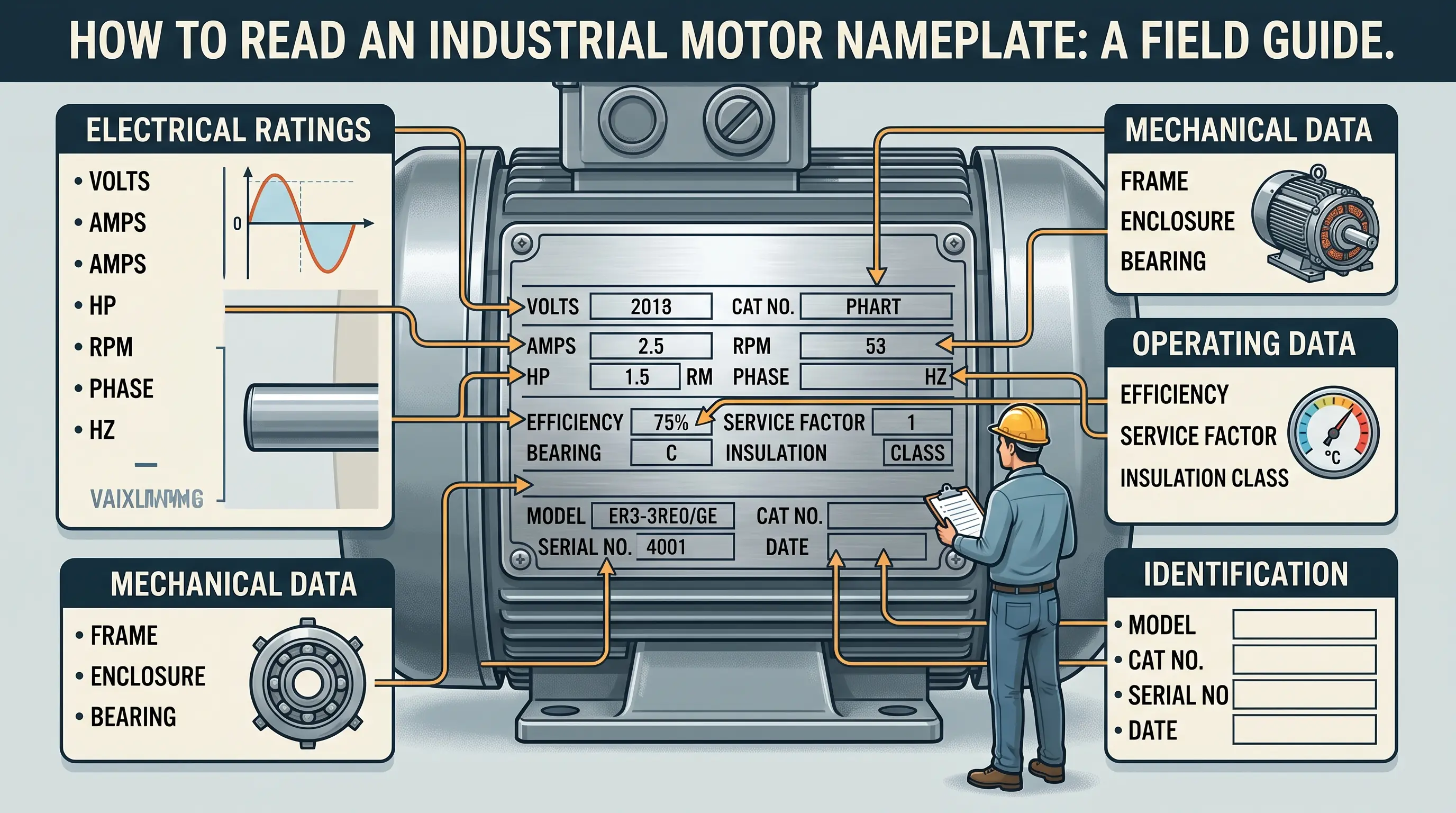
The nameplate (or rating plate) is the motor's official identity card. It is a legal, manufacturer-verified declaration of how the motor was built, what it is rated for, and how it should be connected and protected. If you can read it correctly, you can specify a replacement, check whether a motor is correctly loaded, confirm a part number, and avoid ordering the wrong unit.
Every field on the plate answers a question. Some are electrical, some are mechanical, and some are environmental. This guide walks through each one in the order a technician actually meets them on the plate.
The electrical ratings: how the motor behaves
Rated power (kW / HP)
The most important number. It states the shaft output power the motor is designed to deliver continuously at its rated conditions — not the electrical power it draws. Rated input power will always be higher because of losses.
- kW is used on IEC motors (common in Europe, Asia, and most of the world).
- hp (horsepower) is used on NEMA motors (common in North America).
- One horsepower ≈ 0.746 kW. So a 10 hp motor is roughly a 7.5 kW motor, and vice versa.
Mismatching this figure is the single most common reason a replacement motor fails or runs hot.
Rated voltage (V) and frequency (Hz)
Voltage and frequency are the two values that define the supply the motor expects.
- Voltage: e.g. 230/400 V or 460 V. When two values are listed, they usually correspond to a star (Y) / delta (Δ) connection change.
- Frequency: 50 Hz (most of Europe, Asia, Africa, Australia) or 60 Hz (North America, parts of South America and Asia).
A motor built for 60 Hz will run about 20% faster at 50 Hz unless the volts-per-hertz ratio is corrected. This is why a 60 Hz motor cannot simply be swapped into a 50 Hz network. Many plates list both 50 and 60 Hz columns because the motor was designed for either.
Full-load current (FLA / amps)
The current the motor draws at full rated load, at the rated voltage. This is the value your overload relay and fuses are sized against. Plates often list two current values, one per voltage/connection — make sure you read the one matching your supply.
Frequency-independent speed: rated speed (RPM)
Rated speed is the shaft speed at full load, in revolutions per minute. For a 4-pole motor at 50 Hz that is typically near 1450–1470 rpm (the theoretical synchronous speed is 1500 rpm; slip reduces it). The number of poles relates to speed: more poles means a slower motor.
The mechanical fields: how it is built
Frame size
The frame size is a shorthand for the motor's physical mounting dimensions and shaft height. On IEC motors this is a metric series such as 90S, 112M, 132S, or 160M. On NEMA motors it is something like 56C or 143T. The frame determines bolt spacing, shaft diameter, and mounting, so it must match the driven equipment exactly.
Insulation class
This letter (A, B, F, H) sets the maximum temperature the winding insulation can withstand over its rated life. Class F (155 °C) is the most common on modern industrial motors; Class H (180 °C) is used in hotter environments. A motor running above its insulation class will have a sharply shortened life, even if it does not fail immediately.
Duty type (S1–S10)
The duty class (such as S1, continuous; S3, intermittent periodic; S6, continuous operation with intermittent load) tells you the thermal pattern the motor was designed for. An S1 motor is designed to run continuously at rated load; an intermittent-duty motor cannot be loaded the same way without overheating. Selecting the correct duty class is just as important as matching the power rating.
IP rating (Ingress Protection)
The two-digit IP code, such as IP55 or IP66, describes the motor's sealing. The first digit rates protection against solid objects and dust (0 to 6); the second against water (0 to 9K). IP55 (dust-protected, water-jet protected) is common for general industrial use; washdown or food-grade applications typically need IP56 or higher.
Service factor (SF)
A NEMA field, the service factor tells you how much the motor can be continuously overloaded above nameplate rating without damage. An SF of 1.15 means it can run at 115% of rated load. IEC motors usually have an SF of 1.0 and should not be loaded above nameplate.
The classification fields: efficiency and certification
Efficiency class (IE)
The IE code (IE1, IE2, IE3, IE4) rates the motor's efficiency level under IEC 60034-30-1. IE3 (Premium) and IE4 (Super Premium) are now required for most new low-voltage motors under modern efficiency regulations. A higher IE class means lower electrical losses for the same mechanical output — and lower running cost over the motor's life.
Certification and standards
The plate carries the standards the motor is built to (such as IEC 60034 or NEMA MG 1), plus any certification marks relevant to the application — ATEX or IECEx for hazardous areas, CSA/UL for North America, and so on. For a flameproof motor, always check the gas group, temperature class, and explosion-protection designation on the plate, not just the model name. See our guide to flameproof motors for what those codes mean.
Putting it together: a quick decision table
| Nameplate field |
What it asks |
Key value to read |
| Power (kW/hp) |
What output can it sustain? |
Match the driven load |
| Voltage / Hz |
Which supply does it need? |
Match the network |
| FLA / A |
How much current at full load? |
Sizes protection |
| RPM / poles |
How fast does it turn? |
Must match the driven equipment |
| Frame size |
What mounting and shaft? |
Must match mechanically |
| Insulation class |
How hot can it get? |
Check ambient + load |
| IP rating |
What environment? |
Match washdown / dust / outdoor |
| Duty class (S) |
Can it run continuously? |
Match the load cycle |
| Efficiency (IE) |
How efficient is it? |
Drives running cost |
Common mistakes to avoid
- Reading output power as input. The motor draws more current than its kW rating suggests; size the electrical supply from the full-load current, not the power.
- Mixing star and delta values. Use the current that corresponds to the connection and voltage you actually supply.
- Ignoring the duty class. A continuous-duty requirement means an S1 motor, not an intermittent one.
- Using a 60 Hz motor on 50 Hz. Adjust volts-per-hertz or the motor will overheat and run slow.
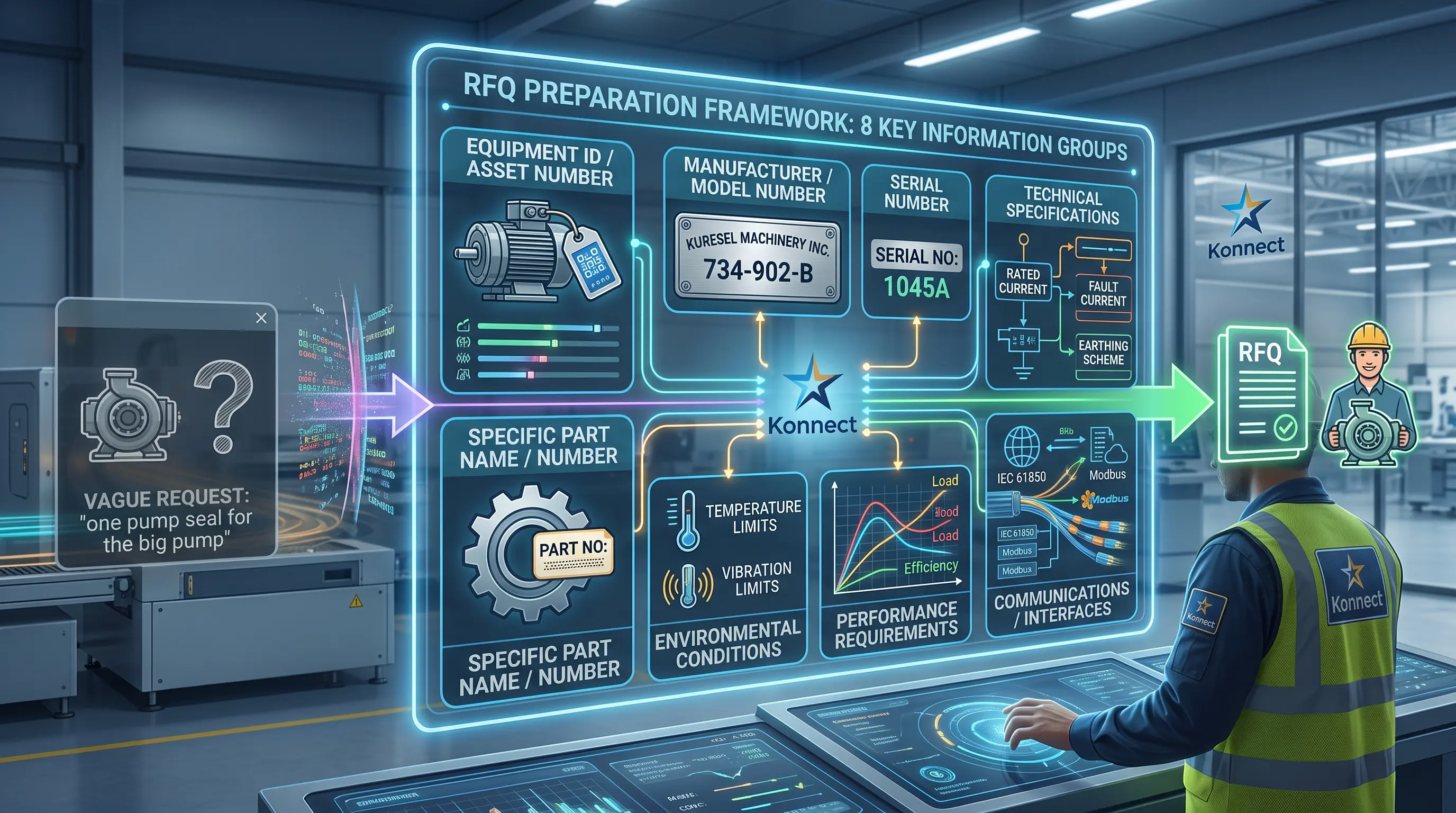
- Not checking the part number. The nameplate also carries the manufacturer part number (MPN), which is the most reliable key to finding the correct spare part. Read it carefully — a single digit or suffix can change the variant. See our guide on finding the right spare part from a part number.
Conclusion
An industrial motor nameplate is not decoration — it is the source of truth for how the motor must be supplied, loaded, and protected. Read the power, voltage, connection, speed, frame, insulation class, duty class, and efficiency, and you will be able to specify a replacement with confidence and keep the motor running within its design limits.
When you are ready to match a motor to your application, browse our electric motor selection guides or send us the nameplate data (model, part number, voltage, power, speed, frame) and we will source the correct unit and genuine spare parts for you.